
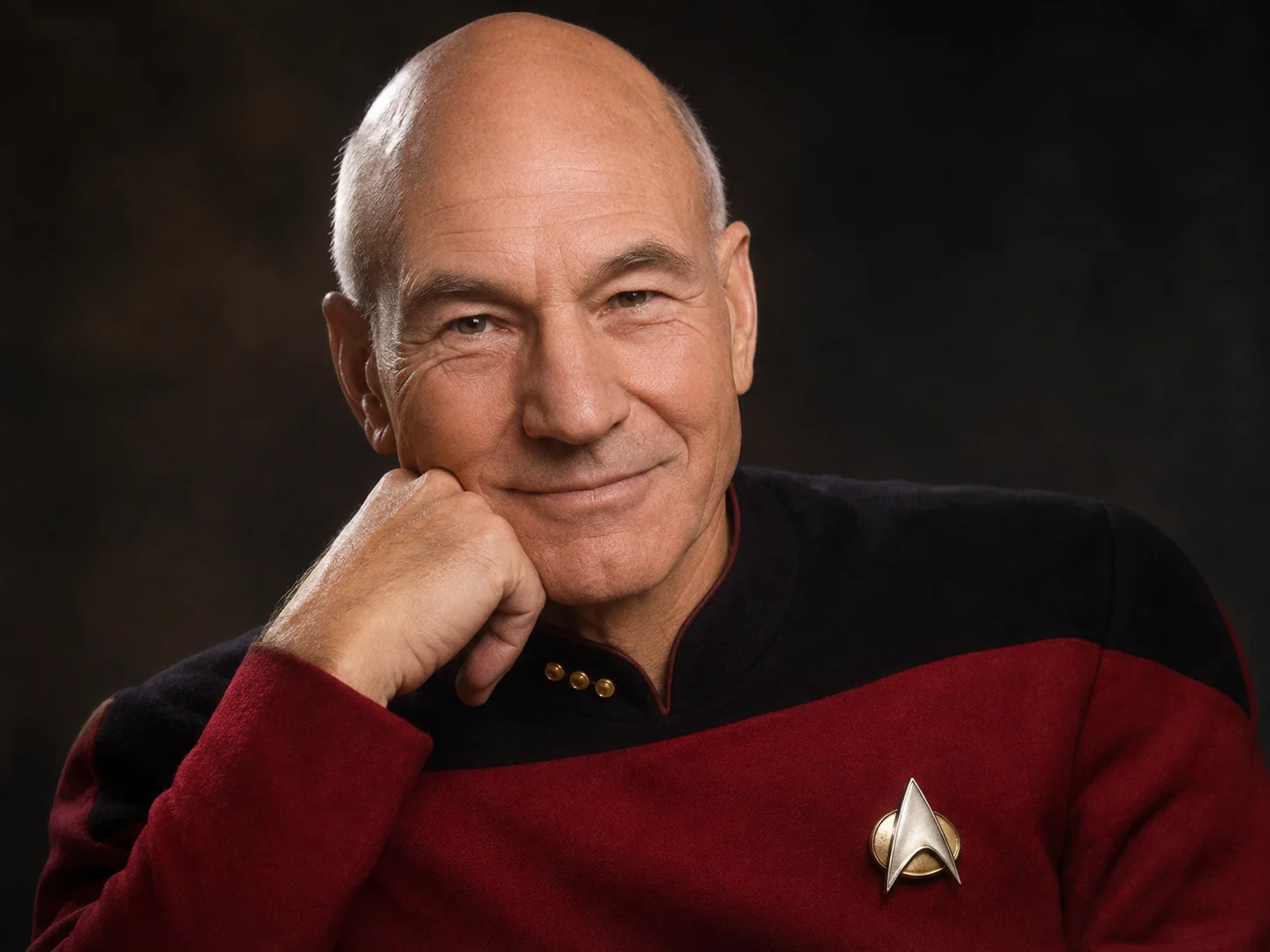
Just over two weeks ago, on 28 October 2026, Sir Patrick Stewart died. Most people will probably remember the British actor as Professor Xavier from X-Men or as Captain Jean-Luc Picard from Star Trek. For me, of course, that second role matters a lot more. Star Trek: The Next Generation was one of the shows I grew up with, and it had a much bigger influence on me than I may have realized.
Over the years, plenty of actors, singers and other famous people whose work I loved and followed have died, but I’ve never reacted like this before. I usually read the news, feel sad, remember a film, a show or a song and move on. But since I read that Patrick Stewart had died, hardly a day has gone by when I haven’t thought about him, about Jean-Luc Picard and about everything that character meant to me at one point in my life. I didn’t cry or fall apart or anything like that. The news just hit me in a way I hadn’t expected, and I’m still trying to understand why.
The closest I can come to describing it is that it felt as if my grandfather had died. I know that might sound a little strange, especially when we’re talking about an actor I never met, but that’s the comparison that’s been going round in my head for days. I never met either of my grandfathers. One died very young, at about thirty, and the other a month before I was born. I never got to grow up with a grandfather, listen to his stories or his advice, or just have somebody older whose experience and way of thinking could set an example for me. I won’t go too far into my family relationships or what else might have been missing when I was growing up. The fact is, I missed having someone like that in my life. When I think about Picard now, I’m more and more convinced I found some of that in him.
From HRT 2 to the Enterprise
I first started noticing Star Trek around 1993, 1994 or 1995. I think it was on HRT 2, the second channel of Croatian public television. That was our particular version of the nineties, with the war, the breakup of Yugoslavia and everything we were living through, which was only slowly beginning to settle down. I was about ten or eleven. I remember coming across the show now and then and watching the odd episode, but it didn’t particularly grab me at the time. The spaceship, the aliens and all their technology were fun to see, but I wasn’t old enough yet to understand what would draw me in so completely a few years later.
I really fell in love with Star Trek around 2001 or 2002, when I was eighteen or nineteen. By then I saw the world differently and got a lot more out of the conversations, the problems and the relationships between the characters, especially what Jean-Luc Picard stood for. I watched episodes, went back and listened to the conversations again, trying to understand what someone meant and why Picard had done what he did in a particular situation. I got so caught up in that world that I often imagined myself as a member of the Enterprise crew, living in the twenty-fourth century, travelling through space, meeting other civilizations and living in a society that had managed to leave at least some of our present-day human stupidity behind.
The closest I can come to describing it is that it felt as if my grandfather had died.
It wasn’t so much the technology that fascinated me, though of course that was part of it too. What fascinated me was the idea that people could live in a world where differences aren’t rejected out of hand, where people try to understand what they don’t know, and where every problem doesn’t have to end in confrontation, insults or force. Of course, things aren’t perfect in Star Trek either. There are wars, conflicts, bad decisions and all the rest. But there’s this basic idea that humanity can move forward, both technologically and as a civilization. That we can become a little better, a little more reasonable and tolerant, and that one day we might feel less need to keep dividing each other up by religion, nationality, skin colour or anything else.
The captain who knew how to listen
And at the centre of all that, for me at least, was Jean-Luc Picard.
What I particularly loved about him was the way he spoke to people, and to all the different beings he encountered. He was captain of one of Starfleet’s most important ships. He had enormous authority, was responsible for hundreds of crew members and often had to make decisions their lives depended on. And yet his first instinct was almost always to hear the other side out, understand what was happening and look for a way through that didn’t involve violence. He was anything but weak, easily swayed or short of opinions. He had extraordinarily firm convictions. He just didn’t think that gave him a reason to put others down or force them to think the way he did.
I especially remember his debates with Q, one of the characters I find most interesting in all of Star Trek. If you haven’t seen the show, Q is a practically omnipotent being who can change space, time and reality on a whim, about as close to a god as you can imagine. So you have this being who can literally do whatever he wants, and one ordinary man who stands up to him with argument, reason and faith in human values. Picard knows full well he’d have no chance against Q in a physical fight. That doesn’t stop him defending what he believes in, even when Q paints all of humanity as a primitive, underdeveloped species.
That dynamic fascinated me because what Picard is trying to prove is that humans can learn, grow and become better, with all our imperfections. To me, that matters a great deal more than some idea that human beings are the smartest or most important creatures in the universe. Star Trek is full of civilizations, different forms of life and beings that do things in ways we can’t even begin to understand. But basic values like respect, understanding and compassion shouldn’t stop applying just because someone looks or thinks completely differently from us.
The person I’d like to be someday
Now that I’m 43 and have children of my own, I understand more and more why a character like that meant so much to me. I can’t say I’ve become Jean-Luc Picard, and I wouldn’t dare compare myself to him. I’m still somebody who loses his temper, gets stubborn, says things he probably shouldn’t and makes plenty of mistakes. But what I’m trying to pass on to my children is a lot like what I heard from Picard all those years. I try to explain how important it is to understand other people, accept differences, have empathy and, maybe most importantly, learn to accept yourself. I don’t always manage it the way I’d like, but it’s something I work towards because it matters to me.
I often think about what kind of grandfather I’d like to be one day, if I’m lucky enough. I’d like to be the one my grandchildren can come to with any question, problem or silly thing without worrying I’ll immediately judge them or give them a lecture. Someone who hears them out, tries to understand and explains what he thinks, while letting them be their own people and make their own decisions. The way Picard knew how to talk to his crew, with enough experience and confidence to listen to somebody else’s opinion too, without always having to prove he was the smartest one in the room.
And maybe that’s why his death brought on this strange feeling of losing a grandfather I never actually had.
Prijevodi Online — People for People
Perhaps the best measure of what Star Trek meant to me is that it led me to start Prijevodi Online in 2004, a website that went on to become familiar to many people looking for Croatian subtitles for foreign TV shows. It started much more modestly than you might imagine today. Those of us who loved science fiction and Star Trek would get together in the old internet discussion groups on Usenet. If I remember correctly, one of the groups was called something like hr.rec.sf.star-trek, and that’s where we’d talk about episodes, characters and whatever else interested us.
It wasn’t easy to find Croatian subtitles for every episode back then. At some point I decided to ask the others whether anyone wanted to join a group effort to translate them. It doesn’t seem like such a big undertaking to me now, but I did have to pluck up the courage to put the idea to people I mostly knew only online. The idea was straightforward: no payment, no profit. Everybody would give what they could and wanted to, and in return we’d all get something we’d never had before. I’d translate the first episode, someone else could take the second, a third person could do the third, and over time we’d make something all of us could use. I decided to start with Encounter at Farpoint, the first episode of The Next Generation, and that’s how it all began.
That’s where I met Marin Bugarić, aka MotheB, then a student at FESB in Split and now a vice dean at the same faculty, and Bruno Zorić from Zagreb, better known as Snyder. I started the project with the two of them. What brought the three of us together was our shared love of Star Trek. We had no business plans and no idea of making any money out of it. We just loved the show and wanted others to be able to watch it with subtitles, too.
I also built the Prijevodi Online website around the idea of “People for People,” which really did sum up the whole project. None of us expected to get paid for the effort, and we had no organization handing out tasks and telling people what to do. People pitched in because they wanted to, because they loved the same shows, because making something useful was fun and because it felt good to know someone else could use their translation. There were hours and hours of work, planning and correcting translations and everything else, but nobody was keeping score of who did how much or what anyone stood to gain.
Now, as I think about Jean-Luc Picard and everything I admired in him, I realize that might have been the moment I tried to follow his example. I wasn’t commanding the Enterprise, of course, and I didn’t have some great vision for changing the world, but I brought people together around an idea we believed in and hoped would help others. The remarkable part is that it really happened. A few people who wanted to translate Star Trek turned into a community where people worked together, helped one another, talked and shared what they knew, regardless of where they came from, what their names were or what nationality they were.
Much more than subtitles
There were Croats, Serbs and people from all sorts of places. What brought us together was a simple love of TV shows and a desire to make something useful. Politics, nationality and money had nothing to do with it. I find that especially striking today when I think about the society we grew up in during the nineties, how divided people were and how often things came down to nationality and belonging. Here we had people working side by side, talking, sharing what they knew and creating something together, and nobody was particularly bothered about where anybody came from. All that mattered was that you wanted to join in and treated everybody decently.
Later I got into other things. I went into the orchard, into apples and growing them, and all the things that took me in a completely different direction over the years. Bruno carried on developing Prijevodi Online. I’m glad the project kept going after I stepped back, but I’m even happier about the stories Bruno would tell me over the years about people who had met through the community. More than subtitles came out of Prijevodi Online. There were friendships, bonds between families through godparents, and even marriages. People who might never have met found each other through something a few of us had started out of a simple love for Star Trek.
Thinking about it, that might be my favourite part of the whole story. We made somewhere people willingly gave their time, knowledge and effort, and what they got back was the feeling of being part of something together. There was no money, political clout or special privilege being handed out. In the end it became a lot more than a subtitle website. People formed relationships that lasted for years, and some, clearly, for life.
We may not have had the Enterprise, but we had our own little community where at least some of the values I admired in the show actually worked.
I don’t want to give the impression that I did all this myself. Without Marin, Bruno and everyone else who pitched in over the years, Prijevodi Online would never have become what it did. But I’m glad I had the nerve to ask that first question and suggest we do something together. Apparently, a pretty simple idea can set a lot more in motion than you might think at first, when the right people gather around it.
It’s only now, writing about Picard, that I see how much it all has to do with what I watched for years in Star Trek. Different people, different ways of thinking, different abilities, all working on something together because they believed it was worth doing and nobody had forced them into it. We may not have had the Enterprise, but we had our own little community where at least some of the values I admired in the show actually worked.
Looking back now, I’m particularly glad I managed to find a backup of the original website from 2005. More than twenty years have passed, and there are still my old posts, my nickname flacus, my thanks to Marin for developing a script to make the work easier and updates about the hundreds of new subtitles people were sending in. In one post from June I even say that some 250 new subtitles had come in and I couldn’t keep up with putting them all on the site. It makes me genuinely happy to read that now and see that my memories are more than some idealized version of my youth. We really did bring together people who freely gave their time to something that nobody expected to make money from.
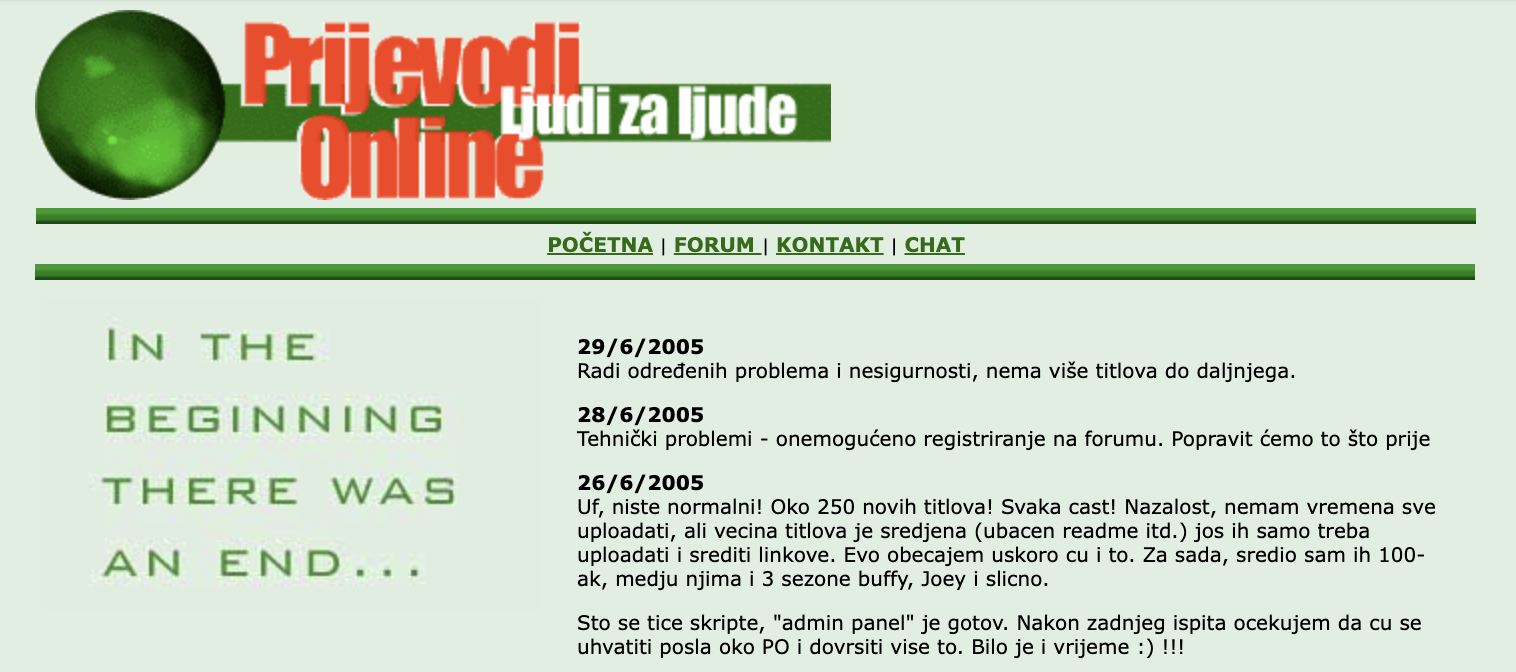
That’s another mark Star Trek left on my life. Because of it I met people I probably never would have met, learned a few things, started an internet project of my own and spent countless hours doing something that made me happy. And when I think about the friendships, family ties and marriages that came out of that community, I’m particularly glad that something that started because of a TV show went on to touch other people’s lives too.
Calm seas, Captain
When I read online just over two weeks ago that Patrick Stewart had died, my first thought was that Jean-Luc Picard was gone. Of course, I know Picard isn’t real and all the episodes and films are still there for me to watch as often as I like. But there won’t be any new moments of seeing that man bring to life again the character who meant so much to us. And I have to admit, it hit me harder than I ever imagined an actor’s death could.
I don’t know what Patrick Stewart was like in private. I didn’t know him, never spoke with him and never got to see him in everyday situations, so I don’t want to write as if we were friends or as if I knew him to be a perfect man. What I do know is that with his acting, his voice, the way he spoke and carried himself, he brought to life a character who mattered an enormous amount to me. Of course, Jean-Luc Picard also owes his existence to the writers, directors and many other people who made Star Trek. But it’s hard to imagine the character having the same effect on me if somebody else had played him.
In the end, what I may regret most is that I never got to tell Patrick Stewart how much the character he played meant to me.
Maybe what’s most interesting is that it’s only now, since his death, that I’ve started connecting certain things in my own life. I hadn’t considered that I might have been looking to Picard for something I’d missed growing up. I’d never really wondered how much that fictional character had shaped the views I hold today, how I relate to people or how I try to raise my own children. But when you look back after all those years, you realize that we’re shaped by our parents, teachers, friends and the people we see every day, and sometimes by someone we’ve never met, even someone who only exists in a television series.
I’ve been reading comments on Facebook, Reddit and elsewhere these past few days, and I can see I’m not the only one who feels this way. Lots of people write about how much Jean-Luc Picard meant to them, how they grew up with him, how his speeches and decisions helped them see the world differently, and how they saw in him an example of the kind of person they wanted to become. It makes me glad to see that I’m not the only one who took something from a starship captain, values that may not always have been easy to find in the real world around us.
In the end, what I may regret most is that I never got to tell Patrick Stewart how much the character he played meant to me. He probably heard thousands of similar stories from Star Trek fans in his lifetime, but I still wish he could have heard mine. I wish he could have known that somewhere in a little country going through a war in the nineties, with everything that came with it, there was a kid who watched Star Trek, went on to translate its episodes and through all those years found something in Jean-Luc Picard that mattered enormously to him.
Most of all, I’d like to tell him I’m grateful that, even through a television screen, he showed me what a person can be when they treat others with understanding, stand up for their values and know that real strength comes from being able to hear somebody out and understand them, not from imposing your will.
So thank you, Sir Patrick Stewart, for all those years, for all those conversations I listened to and all those episodes I watched and rewatched, for the values Jean-Luc Picard taught me to appreciate even more, and for giving a kid who might have been missing just that sort of person in his life somebody he could look up to.
Safe travels, Captain, and calm seas, wherever they take you.
Engage.


0 Comments